

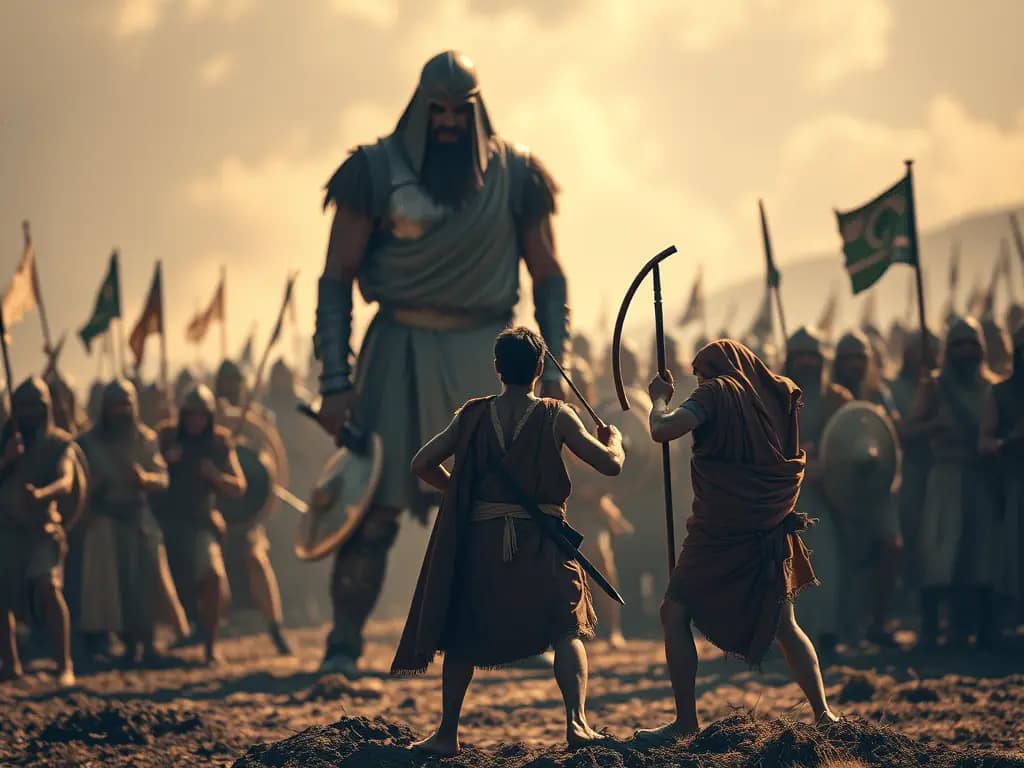
“…Yahweh does not save by sword or by spear; for the battle is Yahweh’s,
and He will give you into our hands.“
– 1 Samuel 17:47, LSB
The story of David and Goliath is too often minimized into a simple moral tale about a young man defeating a warrior through his own personal bravery. Its super easy to admire and even easier to teach. It proves to be incredibly relatable in a world that is desperately trying to feel connected to something. But this interpretation—while accessible—misses the text’s central exegesis. 1 Samuel 17 is not primarily a battle narrative. In fact, out of 54 verses, only two describe the battle itself. The rest focus on a deeper comparison: Namely, the presence or absence of confidence in God; in other words: Who believes that God is not only able… but willing?
What emerges from faithful exegesis then, is not simply a contrast between David and Goliath, but between David and everyone else—Saul, Eliab, the army of Israel. This essentially turns into a case study in what happens when a people lose the praxis of their theological nerve.
The Forty-Day Silence
For forty days, the Philistine mocked the armies of the living God (1 Sam. 17:16). The enemy didn’t hide—he shouted. He didn’t attack—he dared someone to answer. And to the surprise of no one, it was silence.
Israel’s army was not untrained; in fact they were heavily equipped. The real issue they experienced was fear. Saul, once bold in battle, now shrank back in absolute cowardice and Eliab, David’s brother, responded out of frustration, masking his own insecurity by rebuking David (v. 28). The silence was due to spiritual paralysis—the kind that sets in when fear of failure overshadows faith in God.
“The fear of man lays a snare…” (Proverbs 29:25)
…and in this case, it ensnared an entire nation.
David: Not Naïve, but Formed
David enters the scene and immediately breaks the pattern—not because he is reckless, but because he remembers. His confidence is not spontaneous. It’s formed through solitude, shaped by adversity, and grounded in God’s past faithfulness.
“The LORD who delivered me from the paw of the lion and the paw of the bear will deliver me…” (1 Sam. 17:37)
This is not spiritual bravado. It’s memory turned into momentum. And critically, David is not motivated by personal legacy or military glory. His concern is theological:
“Who is this uncircumcised Philistine, that he should defy the armies of the living God?” (v. 26)
What enrages David is not the size of the threat, but the fact that no one seems offended that God’s name is being mocked. This is what sets him apart: a holy jealousy for God’s honor.
The Real Leadership Crisis
This chapter is not simply a vindication of youthful faith—it is an indictment of spiritual cowardice among those who should have led. Saul, who had once fought boldly under the Spirit of God (1 Sam. 11), now cowers in his tent. He offers incentives—wealth, marriage, exemption from taxes (v. 25)—but no leadership.
This is the pattern when spiritual authority lacks spiritual conviction: leaders trade courage for compensation. What’s needed is not strategy or incentive, but someone willing to stand in the name of the Lord.
Here, a sobering truth comes to light: Someone else’s faith cannot carry you through a battle that demands your own faith of you. Israel had systems, history, and power structures, but she lacked the heart to act. David had none of those things that the formal country possessed. What he did have, however, was conviction formed in obscurity and tested under pressure through the watchful eye of God.
A Mirror for Today
1 Samuel 17 forces a question—not whether we admire David, but whether we resemble the silent.
- Do we stand when truth is mocked, or do we rationalize our silence?
- Have we confused safety with faithfulness?
- Do we react to crisis with memory of God’s past provision—or with strategic retreat?
Ultimately, the answers won’t emerge in moments of high visibility. They will be revealed by the disciplines we practice in hidden spaces—where lions and bears come, and no one is watching. What forms in private will be revealed in public.
At its core, this chapter reorients our understanding of victory. David does not claim the battle as his own. He declares, “The battle is the LORD’s” (v. 47)
This is not resignation or abdication of fidelity. Success and failure are not ours to manufacture. Our job is preparation and obedience. The path forward is not about achieving cultural triumph, but about demonstrating our own commitment to God and the faith. When the moment comes to act, whether to speak, to stand, to defend—we are not called to focus solely on winning. We are called to be faithful to God.
“The fear of the Lord is the beginning of wisdom…” (Proverbs 9:10)
And perhaps, in an age of spectacle and compromise, it is also the beginning of courage.
Scriptures Referenced:
- 1 Samuel 17 (primary text)
- 1 Samuel 17:16, 26, 28, 37, 47
- Proverbs 9:10 – “The fear of the Lord is the beginning of wisdom.”
- Proverbs 29:25 – “The fear of man lays a snare, but whoever trusts in the Lord is safe.”
- 1 Samuel 11:6 – Saul’s earlier boldness under the Spirit of God