

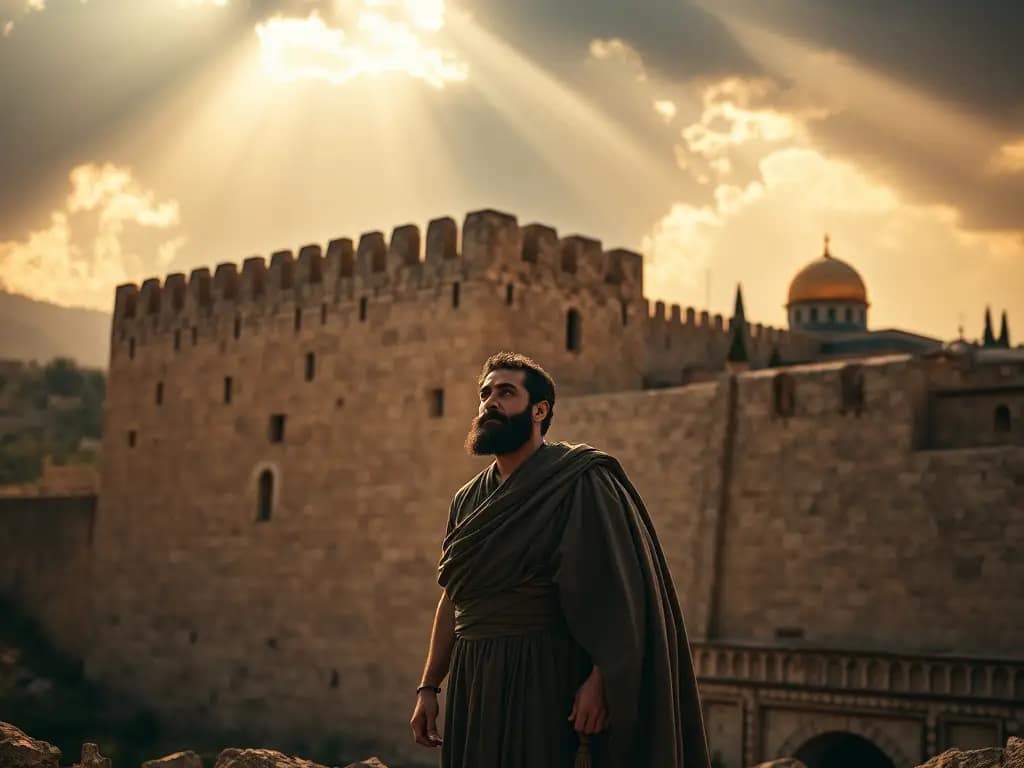
14 Remember me for this, O my God, and do not blot out my lovingkindnesses which I have shown for the house of my God and its responsibilities.
Nehemiah 13:14, LSB
Scripture in Focus: Nehemiah 13
Legacy doesn’t announce itself in the moment—it’s measured in what remains when no one’s watching. In Nehemiah 13, we find a man who’s completed the mission, seen the wall restored, and the people returned. But he doesn’t walk off the field. He steps back in, because he knows something deeper: the work isn’t done when the task is finished. It’s only done when the way is protected.
The project was complete. The people had returned to their homes. The wall—a visible sign of restoration—stood firm. Yet Nehemiah, in what reads like one final sweep of the city and its spiritual condition, reappears with intensity. He surveys the land not just for structure, but for soul. And what he finds is compromise. Corruption has seeped back in. Foreign influence desecrates sacred space. Commitments once loudly proclaimed have quietly eroded.
Four times in this chapter, Nehemiah pleads with God to “remember.” But it’s not just a generic invocation—it’s directional. In one instance, he asks God to remember them, those who profaned the priesthood and broke covenantal practices. But in the other three, he says, in essence: Remember me. Remember what I’ve done. Remember that I fought to restore, to purify, to lead this people back toward You. This contrast is striking. Nehemiah isn’t asking for applause—he’s asking for accountability. For his name to be tethered to the integrity of the work completed.
A Pattern in the Plea
There is no such thing as a finished project if the foundation isn’t protected. No matter how bold the vision, how thorough the planning, or how disciplined the execution—if there is no intentional framework to reinforce what was built, erosion is inevitable. Nehemiah didn’t just repair walls; he reinstated worship, reinstated standards, and, perhaps most critically, reinstated memory. He knew that restoration wasn’t about finishing a task—it was about starting a way of life that could be sustained, guarded, and passed on.
And that’s the difference between a leader and a legacy-maker. One builds for today; the other constructs systems that preserve the way for generations.
The Principle Beneath the Project
Success is a dangerous marker when we let it signal completion. I’ve led projects. I’ve mentored teams. I’ve rebuilt what was broken—in myself, at home, in my leadership. But Nehemiah reminds me that the real test begins after the wall is rebuilt. Because if I don’t take action to cement the better way, I risk seeing it collapse under the weight of familiarity, drift, or disinterest.
At work, it means my role isn’t done once I’ve taught something or elevated someone. Leadership isn’t simply transferring knowledge—it’s embedding wisdom into culture. And for that to happen, I have to actively install new rhythms, create reinforcing systems, and speak to long-term implications; I have to show my people why the principles matter and how those small, iterative steps we’re practicing today create momentum that leads somewhere meaningful—for them, for those they influence, and for the future of the organization. If they can see that, maybe they’ll start thinking about legacy earlier than I did.
And at home, it cuts even deeper. The work isn’t just behavioral correction or rebuilding trust; it’s about laying new tracks, new habits, and new relational architecture. I’ve neglected some of that in the past. But repentance isn’t enough without reconstruction. This season isn’t just about course correction—it’s about culture creation. I’m asking God to remember the work because I want Him to hold me to it. Because if I’m going to lead in His name, I want it to be with a faithfulness that endures.
What It Reveals About My Work and My Witness
I need to be more than a leader. I need to be a legacy-maker. And that means doing the invisible work of reinforcement, even when the walls are already standing tall. It means having the discipline to walk back through the city, to identify cracks early, to correct compromise swiftly—and to keep going, not because the project isn’t finished, but because the people still need shaping.
Because legacies aren’t built in the breakthrough moments. They’re built in what comes after—in the stewardship, in the structure, and in the slow, faithful work of carrying the standard long after others have moved on.
Leadership isn’t finished when the wall is standing. It’s finished when the people walk in the way long after you’re gone. That’s the calling—to not just correct or build, but to cement a better way. A way that endures. A way that is remembered.
Call to Action
This week, take one principle you’re trying to instill—in your team, in your home, or in yourself—and write it down somewhere visible. Then, identify one repeatable habit or rhythm that reinforces it. Just one. Let that be the first brick in building something that lasts. Because legacy is not declared. It’s constructed—brick by intentional brick.